
domingo, noviembre 16, 2008


Colectivo Punto6: Mujeres y urbanismo, Cataluña

 Collectiu Punt6/ Punto6 (mujeres y urbanismo - Cataluña) es un colectivo interdisciplinar de mujeres (artistas, sociologas, urbanistas, arquitectas, curiosas, aventureras.) que exploran nuevas formas de hacer y vivir la ciudad desde su experiencia cotidiana y desde sus profesiones e investigacion colectiva.
A Coruña, Urbanismo y género: inauguración de las primeras jornadas
Jueves, 13/11/2008
El alcalde afirma que el Plan General plantea un urbanismo igualitario para hacer una mejor ciudad
El alcalde, Javier Losada, ha afirmado que el nuevo Plan General de A Coruña plantea un urbanismo sostenible e igualitario, que hará perdurar la ciudad y mejorará el futuro de los vecinos. En la inauguración de las I Jornadas de Urbanismo y Género, ha señalado que el PGOM se fundamenta en el derecho a vivir en una ciudad para todos, que recoja las demandas y necesidades cotidianas de cada persona, así como sus anhelos e ilusiones presentes y futuras.
Javier Losada ha dicho que "sólo hay una forma de hacer urbanismo, y es hacerlo bien, hacer buen urbanismo, urbanismo sostenible e igualitario. Por eso creo firmemente que sólo hay un urbanismo posible: el urbanismo que genera calidad de vida y bienestar; el urbanismo que representa progreso; el urbanismo que hace más ciudad".
El alcalde, por ello, ha indicado que "se trata de plantear un urbanismo que atienda a todos los géneros, sin jerarquías, sin primar a unos sobre otros. Se trata de hacer espacios comunes para todos y todas", y en este sentido ha puesto como ejemplo la movilidad: "Una ciudad la vive el que tiene coche, pero también el que usa el autobús, o el que utiliza silla de ruedas. Un espacio es para el descanso de los mayores, pero también para el entretenimiento de los pequeños. Una ciudad es y debe ser de todos. Y es responsabilidad de todos hacer que así sea".
Por ello ha abogado por el diálogo y ha puesto como ejemplo la transparencia y participación en la redacción y desarrollo del PGOM: "Para hacerlo lo mejor posible, nada mejor que hacerlo desde la participación y el diálogo, participación y diálogo como el que representan estas jornadas".
"Un Plan General que hemos querido desde el principio que nazca del diálogo, el encuentro de opiniones e ideas, el intercambio de experiencias, abierto a todos porque es para todos. Por eso, puedo asegurar que el Plan General de A Coruña será el más abierto y participativo de los posibles, el más sostenible e igualitario. Será el mejor Plan General para hacer la mejor ciudad posible", ha manifestado Javier Losada.
Así, ha mencionado el trabajo que se va a realizar en Eirís: un plan especial para el antiguo núcleo de Eirís, donde se trabajará intensamente y de manera específica por este urbanismo, en un proyecto innovador que además será desarrollado íntegramente por mujeres arquitectas y urbanistas.
En este sentido ha agradecido la labor que realiza la teniente de alcalde de Urbanismo, Mar
Barcón, así como del equipo redactor y el equipo del área municipal de Urbanismo.
El alcalde afirma que el Plan General plantea un urbanismo igualitario para hacer una mejor ciudad
El alcalde, Javier Losada, ha afirmado que el nuevo Plan General de A Coruña plantea un urbanismo sostenible e igualitario, que hará perdurar la ciudad y mejorará el futuro de los vecinos. En la inauguración de las I Jornadas de Urbanismo y Género, ha señalado que el PGOM se fundamenta en el derecho a vivir en una ciudad para todos, que recoja las demandas y necesidades cotidianas de cada persona, así como sus anhelos e ilusiones presentes y futuras.
Javier Losada ha dicho que "sólo hay una forma de hacer urbanismo, y es hacerlo bien, hacer buen urbanismo, urbanismo sostenible e igualitario. Por eso creo firmemente que sólo hay un urbanismo posible: el urbanismo que genera calidad de vida y bienestar; el urbanismo que representa progreso; el urbanismo que hace más ciudad".
El alcalde, por ello, ha indicado que "se trata de plantear un urbanismo que atienda a todos los géneros, sin jerarquías, sin primar a unos sobre otros. Se trata de hacer espacios comunes para todos y todas", y en este sentido ha puesto como ejemplo la movilidad: "Una ciudad la vive el que tiene coche, pero también el que usa el autobús, o el que utiliza silla de ruedas. Un espacio es para el descanso de los mayores, pero también para el entretenimiento de los pequeños. Una ciudad es y debe ser de todos. Y es responsabilidad de todos hacer que así sea".
Por ello ha abogado por el diálogo y ha puesto como ejemplo la transparencia y participación en la redacción y desarrollo del PGOM: "Para hacerlo lo mejor posible, nada mejor que hacerlo desde la participación y el diálogo, participación y diálogo como el que representan estas jornadas".
"Un Plan General que hemos querido desde el principio que nazca del diálogo, el encuentro de opiniones e ideas, el intercambio de experiencias, abierto a todos porque es para todos. Por eso, puedo asegurar que el Plan General de A Coruña será el más abierto y participativo de los posibles, el más sostenible e igualitario. Será el mejor Plan General para hacer la mejor ciudad posible", ha manifestado Javier Losada.
Así, ha mencionado el trabajo que se va a realizar en Eirís: un plan especial para el antiguo núcleo de Eirís, donde se trabajará intensamente y de manera específica por este urbanismo, en un proyecto innovador que además será desarrollado íntegramente por mujeres arquitectas y urbanistas.
En este sentido ha agradecido la labor que realiza la teniente de alcalde de Urbanismo, Mar
Barcón, así como del equipo redactor y el equipo del área municipal de Urbanismo.
domingo, noviembre 09, 2008
A Coruña: URBANISMO y GÉNERO - Eirís de Abaixo
El barrio y el proyecto vistos a través de la Web
Situación
View Larger Map
Plano de gestión del suelo PDF 224 Kb Web urbanismo a Coruña

Punto de partida:
La urbanista canadiense Jane Jacobs, escribió en 1961
Situación
View Larger Map
Plano de gestión del suelo PDF 224 Kb Web urbanismo a Coruña

Punto de partida:
La urbanista canadiense Jane Jacobs, escribió en 1961
"Escribiré principalmente sobre cosas comunes y ordinarias: por ejemplo, qué
tipos de calles son seguros y cuales no; por qué algunos parques son
maravillosos y otros son casi trampas mortales o trampas mortales... En resumen,
escribiré sobre cómo son las ciudades en la vida real porque es la única forma
de conocer qué principios de planeamiento y qué acciones de reconstrucción
pueden promover la vitalidad económica y social de la ciudad y qué acciones y
principios afectarán negativamente a estos atributos".
miércoles, noviembre 05, 2008
Guía para el análisis de la aplicación de la perspectiva de género en la vida cotidiana
El próximo 13 de noviembre, a las 18.00 horas, el Salón Mudéjar del Rectorado de la Universidad de Córdoba acogerá la presentación de la "Guía para el análisis de la aplicación de la perspectiva de género en la vida cotidiana".
Al acto acudirán Rosa Colmenarejo Fernández, presidenta de la asociación Ciudad Tándem; María López Quintana, presidenta de la ONG Maizca; y Marian Ruiz Sánchez, concejala delegada de Igualdad, Cooperación y Solidaridad del Ayuntamiento de Córdoba.Posteriormente, tendrá lugar una mesa redonda en la que intervendrán Esmeralda Morán Muñoz y Mercedes Casado Morán, de la ONG Maizca; Ángela Marín González, de la asociación Débora; y un miembro de la asociación El Despertar.
El debate será moderado por la catedrática de Lingüística de la UCO María Luisa Calero
Invitación: http://www.generourban.org/convocatorias/20081113_tandem_Maizca.pdf
Nota de prensa: http://www.gestion.uco.es/gestion/comunica/actualidad/noticias/?idn=4552
Al acto acudirán Rosa Colmenarejo Fernández, presidenta de la asociación Ciudad Tándem; María López Quintana, presidenta de la ONG Maizca; y Marian Ruiz Sánchez, concejala delegada de Igualdad, Cooperación y Solidaridad del Ayuntamiento de Córdoba.Posteriormente, tendrá lugar una mesa redonda en la que intervendrán Esmeralda Morán Muñoz y Mercedes Casado Morán, de la ONG Maizca; Ángela Marín González, de la asociación Débora; y un miembro de la asociación El Despertar.
El debate será moderado por la catedrática de Lingüística de la UCO María Luisa Calero
Invitación: http://www.generourban.org/convocatorias/20081113_tandem_Maizca.pdf
Nota de prensa: http://www.gestion.uco.es/gestion/comunica/actualidad/noticias/?idn=4552
martes, octubre 21, 2008
Gendersite: recursos en línea y en inglés sobre género y entorno construido
 UK Gendersite http://www.gendersite.org/
 Online resource for gender and the built environment
Enlaces, documentos, buenas prácticas
Enlaces, documentos, buenas prácticas
Un proyecto de
Women's Design Service http://www.wds.org.uk/
Urbanbuzz
y Queen Mary, University of London
jueves, octubre 09, 2008
A Coruña: URBANISMO y GÉNERO - Jornadas
 las Jornadas de "URBANISMO Y GÉNERO: ESPACIO COMÚN" se celebrarán en la FUNDACIÓN CAIXA GALICIA los días 13 y 14 de noviembre de 2008.
Jueves, 17/7/2008 - Actualización Jueves 09/10/2008 y 16/11/2008
Mar Barcón presentó las Jornadas sobre Urbanismo y Género que se celebrarán en la ciudad el próximo mes de noviembre
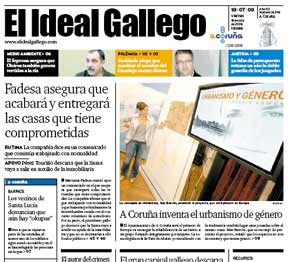
El Ayuntamiento incorpora la perspectiva de género al desarrollo urbanístico con un proyecto específico para Eirís de Abajo.
La responsable del área de Urbanismo municipal aprovechó la presentación de las jornadas para anunciar que A Coruña será una de las primeras ciudades en pasar de la teoría a la práctica en cuanto a perspectiva de género aplicada al urbanismo. ...
Barcón subrayó su satisfacción por la decisión de encargar sólo a mujeres adscritas al departamento de Urbanismo el desarrollo del núcleo de Eirís de Abajo porque supone un paso muy importante y de gran visibilidad para la incorporación de la perspectiva de género a toda la acción municipal.
Barcón aseguró al respecto que los espacios urbanos «no son inocentes y tienen género a la hora de diseñarse a sí mismos».
Entre otras profesionales, están invitadas Inés Sánchez de Madariaga, Belén Sanjurjo y Carmen Cid. Está previsto que a las jornadas acudan la ministra de Igualdad, Bibiana Aído, y la conselleira de Política Territorial, María Xosé Caride.
Entre otras profesionales, están invitadas Inés Sánchez de Madariaga, Belén Sanjurjo y Carmen Cid. Está previsto que a las jornadas acudan la ministra de Igualdad, Bibiana Aído, y la conselleira de Política Territorial, María Xosé Caride.
Fuente
Organización e Incripciones
Instituto AZIMUT -
http://institutoazimut.blogspot.com/2008/08/i-jornada-de-urbanismo-y-gnero-espacio.html
Instituto AZIMUT -
http://institutoazimut.blogspot.com/2008/08/i-jornada-de-urbanismo-y-gnero-espacio.html
Nota de prensa inauguración
http://generourban.blogspot.com/2008/11/coruna-urbanismo-y-genero-inauguracion.html
http://generourban.blogspot.com/2008/11/coruna-urbanismo-y-genero-inauguracion.html
_____________
Blogs relacionados:
Blog de Mar Barcón http://barconblog.blogspot.com/
Blog de Túzaro http://gritatuzaro.blogspot.com/
En la prensa:El primer barrio europeo diseñado y planeado exclusivamente por ... La Gaceta de los Negocios - 17 Jul 2008A Coruña tendrá un barrio diseñado sólo por mujeres El País (España), Spain
- 18 Jul 2008
El ayuntamiento encarga la reforma del barrio de Eirís a un grupo ... La Opinión A Coruña, Spain - 17 Jul 2008
domingo, septiembre 28, 2008
Mujeres y hombres: un desigual derecho a acceder a la propriedad
ES - ¿Sabías que en más de 25 países del mundo es casi imposible
para una una mujer acceder a la propriedad inmobiliaria (tierra,
casa...)?
FR - Saviez-vous que dans plus de 25 pays du monde, il est presque impossible pour une femme d'être propriétaire foncière?
EN - Did you know that in more than 25 countries of the world it is close to impossible for women to own land?
Fuente: Wikigender
http://www.wikigender.org/wiki/index.php?title=Access_to_property
http://www.wikigender.org/wiki/index.php?title=GID_Variables:_Social_Institutions
Unesco gender equality Quiz 2007 - Test your knowledge
Gender Equality + UNESCO’s experience in promoting gender equality Portal
Esta presentación en inglés explica de manera sencilla y en forma de quizz la igualdad entre mujeres y hombres. Explica por ejemplo la diferencias entre sexo y género.
http://portal.unesco.org/en/ev.php-URL_ID=3160&URL_DO=DO_TOPIC&URL_SECTION=201.html
sábado, septiembre 20, 2008
Gender mainstreaming - perspectiva de género
Legend:
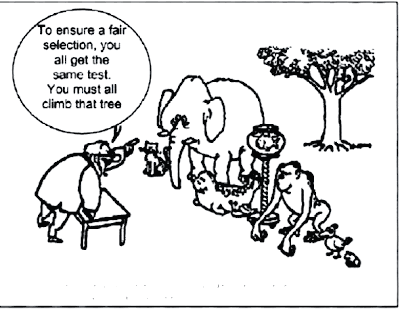
The cartoon shows a man behind a desk in a jungle clearing addressing a line up of various criature - cat, monkey, sea-lion, snake, frog and a goldfish in a bowl on a pedestal. "To ensure a fair selection you all get the same test" he says. "You must all climb that tree." (1) and (2)
"Para garantizar una selección justa, todos van a hacer la misma prueba – subir aquel árbol"
"Gender mainstreaming is the (re)organisation, improvement, development and evaluation of policy processes, so that a gender equality perspective is incorporated in all policies at all levels and at all stages, by the actors normally involved in policy-making. " COE EG-S-MS(1998)2rev
Gender mainstreaming does not replace specific policies which aim to redress situations resulting from gender inequality. Specific gender equality policies and gender mainstreaming are complementary and must go together to reach the goal of gender equality.
1 Why is it important to consider gender equality issues in mainstream policies?
"There is a dominant ethos in Western societies that opportunities should be equally open to all people, which is a fair and positive aspiration. However, it can be difficult for all people to access opportunities equally, as the cartoon shows.Clearly some of the animals will find it much easier than others to climb the tree! A recognition of this inequality forms the underlying principle of gender mainstreaming: the process of gender mainstreaming begins with acknowledging the fact that women and men are not able to access opportunities with the same ease. (1) (2) (3)
Mainstreaming includes gender-specific activities and affirmative action, whenever women or men are in a particularly disadvantageous position. Gender-specific interventions as positive discrimination can target women exclusively, men and women together, or only men, to enable them to participate in and benefit equally from development efforts. These are necessary temporary measures designed to combat the direct and indirect consequences of past discrimination.In order for men and women to be equally able to avail of all services and facilities, policy makers need to take account of the different situations and lifestyles of men and women, and plan for this. " (5)
Mainstreaming includes gender-specific activities and affirmative action, whenever women or men are in a particularly disadvantageous position. Gender-specific interventions as positive discrimination can target women exclusively, men and women together, or only men, to enable them to participate in and benefit equally from development efforts. These are necessary temporary measures designed to combat the direct and indirect consequences of past discrimination.In order for men and women to be equally able to avail of all services and facilities, policy makers need to take account of the different situations and lifestyles of men and women, and plan for this. " (5)
Many governments and organisations have adopted gender mainstreaming as a strategy to promote equal opportunities between women and men in their Development Plan. Gender mainstreaming has therefore been adopted to promote equality between women and men in the following plans:
- Ireland "National Development Plan 2000-2006".
- UE "roadmap for equality between women and men 2006-2010"
- ....
2 Examples:
2.1 - Access to services and facilities in Ireland (3)
This is the basis for mainstreaming equality. Underlying the concept of mainstreaming is recognition of the fact that not all groups or individuals in a society have the same ease in accessing opportunities. In order for all groups of people to be equally able to access the services and facilities, mainstream policies need to take account of the different ability of different groups to benefit, and plan for this. In this case we are concerned about the ability of women and men to access services and facilities provided by mainstream policies. A few statistics illustrate that women and men do not access services and facilities to the same extent or in the same way. To take a quick example, 63% of Irish men have a full driving licence, compared to 46% of Irish women . This difference is most significant in urban areas, and means women are more reliant on public transport than men, so are likely to access it more. In addition 73% of men are in the labour force compared to 50% of women. So women are more likely than men to be travelling to non-work facilities, such as shops, schools, health centres, and childcare facilities. Putting a gender equality perspective in mainstream transport policies thus means considering public transport provision not to just to work, but also to these other facilities to which women are more likely than men to travel, and taking these issues into account as policy is developed and implemented...
... More examples...
3 Main definitions:
(3a)European Commision
Gender mainstreaming is the systematic integration of the respective situations, priorities and needs of women and men in all policies and with a view to promoting equality between women and men and mobilising all general policies and measures specifically for the purpose of achieving equality by actively and openly taking into account, at the planning stage, their effects on the respective situations of women and men in implementation, monitoring and evaluation. (Commission Communication COM (96) 67 final of 21/02/96). 100 words for equality
(3b) United Nations "Mainstreaming a gender perspective is the process of assessing the implications for women and men of any planned action, including legislation, policies or programmes, in all areas and at all levels. It is a strategy for making women's as well as men's concerns and experiences an integral dimension of the design, implementation, monitoring and evaluation of policies and programmes in all political, economic and societal spheres so that women and men benefit equally and inequality is not perpetuated.The ultimate goal is to achieve gender equality."
(UN General Assembly A/52/3 18 September 1997)
(3c) Council of Europe (COE)..."Gender mainstreaming, as a new concept, appeared for the first time in international texts after the United Nations Third World Conference on Women (Nairobi, 1985), in relation to the debate within the UN Commission on the Status of Women (CSW) on the role of women in development."..."At the United Nations Fourth World Conference on Women (Beijing, 1995), the strategy of gender mainstreaming was explicitly endorsed by the Platform for Action which was adopted at the end of the Conference. The Platform for Action calls for the promotion of the policy of gender mainstreaming, repeatedly stating that "governments and other actors should promote an active and visible policy of mainstreaming a gender perspective in all policies and programmes, so that, before decisions are taken, an analysis is made of the effects on women and men, respectively"...
"Gender mainstreaming is the (re)organisation, improvement, development and evaluation of policy processes, so that a gender equality perspective is incorporated in all policies at all levels and at all stages, by the actors normally involved in policy-making. " COE EG-S-MS(1998)2rev
4 Sources:
(1) This cartoon was originally published in:(DGXXII (1995) Alpha Toolkit: Make changes for today which will be solutions for tomorrow, Brussels: DGXXII European Commission, p. 25
(2) Cartoon legend:Mainstreaming Equality in the European Union: Education, Training and Labour Market Policies (PDF Google) By Teresa L. ReesPublished by Routledge, 1998ISBN 0415115337, 9780415115339 260 pages, p. 26
(3) Text adapted from NDP Gender Equality Unit Department of Justice, Equality and Law Reform , Ireland
(5) ILO 2002
http://www.ilo.org/public/english/bureau/gender/newsite2002/about/defin.htm
(6) Council of Europe and gender mainstraming
http://www.coe.int/t/e/human_rights/equality/02._Gender_mainstreaming/
(7) International Telecommunications Union and gender mainstreaming
http://www.itu.int/ITU-D/gender/gender_mainstreaming_activities.html
(8) Unesco Gender Maintraming
http://portal.unesco.org/en/ev.php-URL_ID=10996&URL_DO=DO_TOPIC&URL_SECTION=201.html
(9) United Nations - Office of the Special Adviser on Gender Issues and Advancement of Women
http://www.un.org/womenwatch/osagi/gendermainstreaming.htm
http://www.un.org/womenwatch/osagi/gendermainstreaming.htm
Suscribirse a:
Entradas (Atom)
8 mars 2010: J'affiche mes couleurs
 8 mars 2010
.
Participez à la campagne "J’affiche mes couleurs en faveur du camp de solidarité international Myriam Merlet, Anne-Marie Coriolan et Magalie Marcelin".
.
Plus d'infos ici : http://www.oregand.ca/veille/2010/03/jaffiche-mes-couleurs-en-faveur-du-camp-de-solidarite-international-des-femmes-dhaiti.html
8 mars 2010
.
Participez à la campagne "J’affiche mes couleurs en faveur du camp de solidarité international Myriam Merlet, Anne-Marie Coriolan et Magalie Marcelin".
.
Plus d'infos ici : http://www.oregand.ca/veille/2010/03/jaffiche-mes-couleurs-en-faveur-du-camp-de-solidarite-international-des-femmes-dhaiti.html