jueves, octubre 09, 2008

A Coruña: URBANISMO y GÉNERO - Jornadas

las Jornadas de "URBANISMO Y GÉNERO: ESPACIO COMÚN" se celebrarán en la FUNDACIÓN CAIXA GALICIA los días 13 y 14 de noviembre de 2008.

Jueves, 17/7/2008 - Actualización Jueves 09/10/2008 y 16/11/2008


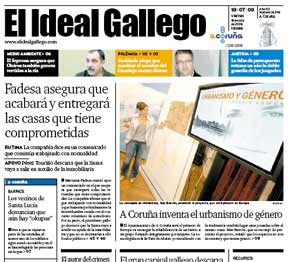
Mar Barcón presentó las Jornadas sobre Urbanismo y Género que se celebrarán en la ciudad el próximo mes de noviembre

El Ayuntamiento incorpora la perspectiva de género al desarrollo urbanístico con un proyecto específico para Eirís de Abajo.

La responsable del área de Urbanismo municipal aprovechó la presentación de las jornadas para anunciar que A Coruña será una de las primeras ciudades en pasar de la teoría a la práctica en cuanto a perspectiva de género aplicada al urbanismo. ...

Barcón subrayó su satisfacción por la decisión de encargar sólo a mujeres adscritas al departamento de Urbanismo el desarrollo del núcleo de Eirís de Abajo porque supone un paso muy importante y de gran visibilidad para la incorporación de la perspectiva de género a toda la acción municipal.
Barcón aseguró al respecto que los espacios urbanos «no son inocentes y tienen género a la hora de diseñarse a sí mismos».

Entre otras profesionales, están invitadas Inés Sánchez de Madariaga, Belén Sanjurjo y Carmen Cid. Está previsto que a las jornadas acudan la ministra de Igualdad, Bibiana Aído, y la conselleira de Política Territorial, María Xosé Caride.

Fuente


_____________

domingo, septiembre 28, 2008

Mujeres y hombres: un desigual derecho a acceder a la propriedad

ES - ¿Sabías que en más de 25 países del mundo es casi imposible
para una una mujer acceder a la propriedad inmobiliaria (tierra,
casa...)?


FR - Saviez-vous que dans plus de 25 pays du monde, il est presque impossible pour une femme d'être propriétaire foncière?

EN - Did you know that in more than 25 countries of the world it is close to impossible for women to own land?

Fuente: Wikigender
http://www.wikigender.org/wiki/index.php?title=Access_to_property
http://www.wikigender.org/wiki/index.php?title=GID_Variables:_Social_Institutions

Unesco gender equality Quiz 2007 - Test your knowledge


Gender Equality + UNESCO’s experience in promoting gender equality Portal

Esta presentación en inglés explica de manera sencilla y en forma de quizz la igualdad entre mujeres y hombres. Explica por ejemplo la diferencias entre sexo y género.
http://portal.unesco.org/en/ev.php-URL_ID=3160&URL_DO=DO_TOPIC&URL_SECTION=201.html

sábado, septiembre 20, 2008

Gender mainstreaming - perspectiva de género


Legend:
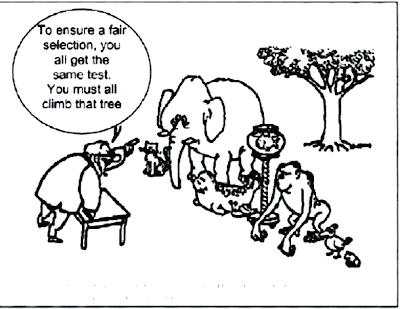
The cartoon shows a man behind a desk in a jungle clearing addressing a line up of various criature - cat, monkey, sea-lion, snake, frog and a goldfish in a bowl on a pedestal. "To ensure a fair selection you all get the same test" he says. "You must all climb that tree." (1) and (2)


"Para garantizar una selección justa, todos van a hacer la misma prueba – subir aquel árbol"


"Gender mainstreaming is the (re)organisation, improvement, development and evaluation of policy processes, so that a gender equality perspective is incorporated in all policies at all levels and at all stages, by the actors normally involved in policy-making. " COE EG-S-MS(1998)2rev


Gender mainstreaming does not replace specific policies which aim to redress situations resulting from gender inequality. Specific gender equality policies and gender mainstreaming are complementary and must go together to reach the goal of gender equality.


1 Why is it important to consider gender equality issues in mainstream policies?


"There is a dominant ethos in Western societies that opportunities should be equally open to all people, which is a fair and positive aspiration. However, it can be difficult for all people to access opportunities equally, as the cartoon shows.Clearly some of the animals will find it much easier than others to climb the tree! A recognition of this inequality forms the underlying principle of gender mainstreaming: the process of gender mainstreaming begins with acknowledging the fact that women and men are not able to access opportunities with the same ease. (1) (2) (3)
Mainstreaming includes gender-specific activities and affirmative action, whenever women or men are in a particularly disadvantageous position. Gender-specific interventions as positive discrimination can target women exclusively, men and women together, or only men, to enable them to participate in and benefit equally from development efforts. These are necessary temporary measures designed to combat the direct and indirect consequences of past discrimination.In order for men and women to be equally able to avail of all services and facilities, policy makers need to take account of the different situations and lifestyles of men and women, and plan for this. " (5)


Many governments and organisations have adopted gender mainstreaming as a strategy to promote equal opportunities between women and men in their Development Plan. Gender mainstreaming has therefore been adopted to promote equality between women and men in the following plans:


  • Ireland "National Development Plan 2000-2006".

  • UE "roadmap for equality between women and men 2006-2010"

  • ....


2 Examples:
2.1 - Access to services and facilities in Ireland (3)
This is the basis for mainstreaming equality. Underlying the concept of mainstreaming is recognition of the fact that not all groups or individuals in a society have the same ease in accessing opportunities. In order for all groups of people to be equally able to access the services and facilities, mainstream policies need to take account of the different ability of different groups to benefit, and plan for this. In this case we are concerned about the ability of women and men to access services and facilities provided by mainstream policies. A few statistics illustrate that women and men do not access services and facilities to the same extent or in the same way. To take a quick example, 63% of Irish men have a full driving licence, compared to 46% of Irish women . This difference is most significant in urban areas, and means women are more reliant on public transport than men, so are likely to access it more. In addition 73% of men are in the labour force compared to 50% of women. So women are more likely than men to be travelling to non-work facilities, such as shops, schools, health centres, and childcare facilities. Putting a gender equality perspective in mainstream transport policies thus means considering public transport provision not to just to work, but also to these other facilities to which women are more likely than men to travel, and taking these issues into account as policy is developed and implemented...
... More examples...


3 Main definitions:

(3a)European Commision
Gender mainstreaming is the systematic integration of the respective situations, priorities and needs of women and men in all policies and with a view to promoting equality between women and men and mobilising all general policies and measures specifically for the purpose of achieving equality by actively and openly taking into account, at the planning stage, their effects on the respective situations of women and men in implementation, monitoring and evaluation. (Commission Communication COM (96) 67 final of 21/02/96). 100 words for equality

(3b) United Nations "Mainstreaming a gender perspective is the process of assessing the implications for women and men of any planned action, including legislation, policies or programmes, in all areas and at all levels. It is a strategy for making women's as well as men's concerns and experiences an integral dimension of the design, implementation, monitoring and evaluation of policies and programmes in all political, economic and societal spheres so that women and men benefit equally and inequality is not perpetuated.The ultimate goal is to achieve gender equality."
(UN General Assembly A/52/3 18 September 1997)

(3c) Council of Europe (COE)..."Gender mainstreaming, as a new concept, appeared for the first time in international texts after the United Nations Third World Conference on Women (Nairobi, 1985), in relation to the debate within the UN Commission on the Status of Women (CSW) on the role of women in development."..."At the United Nations Fourth World Conference on Women (Beijing, 1995), the strategy of gender mainstreaming was explicitly endorsed by the Platform for Action which was adopted at the end of the Conference. The Platform for Action calls for the promotion of the policy of gender mainstreaming, repeatedly stating that "governments and other actors should promote an active and visible policy of mainstreaming a gender perspective in all policies and programmes, so that, before decisions are taken, an analysis is made of the effects on women and men, respectively"...

"Gender mainstreaming is the (re)organisation, improvement, development and evaluation of policy processes, so that a gender equality perspective is incorporated in all policies at all levels and at all stages, by the actors normally involved in policy-making. " COE EG-S-MS(1998)2rev

4 Sources:

(1) This cartoon was originally published in:(DGXXII (1995) Alpha Toolkit: Make changes for today which will be solutions for tomorrow, Brussels: DGXXII European Commission, p. 25

(2) Cartoon legend:Mainstreaming Equality in the European Union: Education, Training and Labour Market Policies (PDF Google) By Teresa L. ReesPublished by Routledge, 1998ISBN 0415115337, 9780415115339 260 pages, p. 26

(3) Text adapted from NDP Gender Equality Unit Department of Justice, Equality and Law Reform , Ireland

(5) ILO 2002
http://www.ilo.org/public/english/bureau/gender/newsite2002/about/defin.htm

(6) Council of Europe and gender mainstraming
http://www.coe.int/t/e/human_rights/equality/02._Gender_mainstreaming/

(7) International Telecommunications Union and gender mainstreaming
http://www.itu.int/ITU-D/gender/gender_mainstreaming_activities.html

(8) Unesco Gender Maintraming
http://portal.unesco.org/en/ev.php-URL_ID=10996&URL_DO=DO_TOPIC&URL_SECTION=201.html

(9) United Nations - Office of the Special Adviser on Gender Issues and Advancement of Women
http://www.un.org/womenwatch/osagi/gendermainstreaming.htm
(10) Gender Maintreaming: a tool for change
A European Community of Practice with EQUAL Management Authorities of Finland, Belgium (Flanders), Ireland, Italy, Portugal, Spain and Styria

sábado, septiembre 13, 2008

informe de la UE, diferencias de sueldo entre mujeres y hombres


Waging war on the pay gap: 8 de marzo de 2008

Diferencias salariales entre hombres y mujeres

En la economía de la UE, las mujeres siguen ganando, como media un 15% menos que los hombres, según la Comisión Europea. El informe publicado en julio de 2007 establece la manera en que la UE puede reducir esas diferencias, que apenas han cambiado durante la última década. La diferencia salarial entre hombres y mujeres representa la diferencia entre el sueldo medio por hora de hombres y mujeres antes de impuestos. Refleja la discriminación y desigualdad que existe en el mercado laboral, que, en la práctica, afecta principalmente a las mujeres.

Seguir leyendo
Reference: IP/07/1115 Date: 18/07/2007

jueves, septiembre 11, 2008

España: Soló un 15% de los alcaldes son mujeres

El perfil del alcalde español es el de un hombre de entre 46 y 65 años con estudios medios
lunes, 25 de agosto de 2008
El perfil del alcalde español es el de un hombre, de entre 46 y 65 años, con estudios de Bachillerato o equivalente y cuya actividad profesional está relacionada mayoritariamente con el sector servicios. Éste es el perfil que se desprende del Registro de Representantes Electos del Ministerio de Administraciones Públicas...

La participación femenina en la política local española ha crecido un 17% en cuatro años, pero todavía es baja a proporción de alcaldesas. Sólo un 15% de de los ediles y un 31% de concejales son mujeres.


Enlaces:

viernes, septiembre 05, 2008

Prabha Khosla: Gender in Local Government - Genero no Governo Local

Gender in Local Government: A Sourcebook for Trainers (EN-PT- bientôt en FR)
by Prabha Khosla, Publication UN-Habitat, 2008
Local governments have significant responsibilities to strengthen gender equality in decision making, development policies and planning, and service delivery.

This manual, 'Gender in Local Government: A Sourcebook for Trainers' is designed to assist training institutions in mainstreaming gender incapacity building for local government. It consists of gender concepts, gender analysis and tools in areas of local government.

The following key issues of local governance have been selected:
  • participation in local government,
  • land rights,
  • urban planning,
  • service provision,
  • local government financing,
  • violence against women and
  • local economic development.

Numerous case studies illustrate what local governments can do to strengthen gender mainstreaming in their work. Reflection questions, training exercises and guidelines for conducting gender trainings will help trainers to develop successful trainings. It is hoped that it will provide valuable insights and resources for trainers and training institutions to improve their training courses tostrengthen the capacity of local governments to deliver.

To find "Gender in Local Government: A Sourcebook for Trainers" go to the following web page and scroll down to see the book. You can download it in pdf format. Or you can also buy the book from the same site.

http://www.unhabitat.org/pmss/ (EN)

http://www.unhabitat.org/pmss/getPage.asp?page=bookView&book=2508 (PT)

Your critical feedback and comments are most appreciated.

Prabha
-----------
Prabha Khosla es moderadora del grupo Toronto Women's City Alliance (TWCA).


Reference:

Gender in Local Government: A Sourcebook for Trainers -by Prabha Khosla, Publication UN-Habitat, 140 p, 2008
PDF 2923Kb with free download, Price paper book: $15

domingo, agosto 31, 2008

Conferencia Mujeres en la ciudad OCDE-OECD 1994

OECD Conference on Women in the City

OECD Headquarters 4 to 6 October 1994

Women in the city: housing, services, and the urban environment; Paris: Organisation for Economic Co-operation and Development; Washington, D.C. : OECD Publications and Information Center; 1995. 170 p.

Femmes (les) et la ville: logement, services et environnement urbain; Paris; OCDE (Inter Organisation de Coopération et de Developpement Economiques). 1995


Referencia para construir ciudades con perspectiva de género *****


Esta publicación contiene las intervenciones presentadas a la conferencia sobre la mujer y la ciudad, organizada por la OCDE. Se centran en los problemas que se plantean a las mujeres en el entorno urbano y en la necesidad de examinar las políticas de los países de la OCDE con el fin de mejorar la posición de las mujeres en la ciudad.


La conferencia se dividió en tres partes:


1) las mujeres y las políticas urbanas, en la que se contempla la necesidad de que las mujeres participen en las políticas Urbanas,


2) alojamiento y entorno para las mujeres y los niños- donde se reconoce que la calidad de vida de las mujeres y niños depende de la posibilidad de vivir en un entorno sano y seguro,


3) servicios urbanos adaptados a las necesidades de las mujeres y niños, que aborda el tema del reparto de las cargas familiares, los medios para facilitar la movilidad de las mujeres en las ciudades y la mejora de las posibilidades de educación y empleo para las mujeres.


ENLACES y FUENTES:
Las conclusiones en formato html y la publicación en formato PDF se encuentran disponibles desde Wikigender, la wiki sobre igualdad y género de la OCDE
http://www.wikigender.org/wiki/index.php?title=Cities_-_Women_in_the_city_-_OECD_Conference_1994

sábado, agosto 30, 2008

Calles con nombres de mujeres

De blog en blog, lecturas, extracto


29 Ago 2008
Calles con nombres de mujeres para La Guancha (Tenerife)


Plazoleta Ángeles Machado, en La Guancha

... "Calles con nombre y en honor de mujeres

Cinco mujeres que son representativas de una época, que fueron protagonistas de la historia de Tenerife o de España durante el siglo pasado. Azucena Rojas, Carmen Goya, Rosario Sánchez Mora ’La Dinamitera’, Victoria Kent y Concepción Arenal darán nombre a media decena de nuevas vías del barrio de la Luz, en La Orotava. La decisión la ha adoptado el Ayuntamiento de la Villa casi por unanimidad (CC, PSOE, IpO e IUC-LV votaron a favor y PP se abstuvo), tras aprobarse previamente en la Comisión Informativa de Educación, Cultura, Deportes, Juventud y Fiestas la propuesta que formuló el concejal de Izquierda Unida Canaria-Los Verdes (IUC-LV) Fran Baute.

El Consistorio destaca que todas estas féminas se caracterizaron por su proyección social y su relevancia en la historia social y política más reciente del Archipiélago y de España. Pero sobre todo, su singularidad hay que buscarla en la decidida reivindicación y lucha que encabezaron en defensa de los derechos de la mujer. Ésta es la causa de que también se haya propuesto que la nueva urbanización de la Luz en la que están ubicadas dichas calles se denomine ’8 de Marzo’, una fecha que ha sido asignada para conmemorar el Día Internacional de la Mujer.

Las cinco personas a las que ahora La Orotava les brinda este reconocimiento desafiaron las normas de su época y defendieron sus ideas hasta la muerte. A varias de ellas, esta actitud les supuso pasar varios años en prisión. El paso del tiempo y la evolución en las ideas ha hecho que se las mire hoy como personas muy significativas, de gran trascendencia histórica, y su recuerdo, tal como recalca la corporación local, merece la adjudicación de sus nombres a estas calles de la Villa."...
Escrito por: jecalorena el 29 Ago 2008 - URL Permanente

8 mars 2010: J'affiche mes couleurs

Logo de la campaña j'affiche les couleurs Haiti 8 mars 2010 . Participez à la campagne "J’affiche mes couleurs en faveur du camp de solidarité international Myriam Merlet, Anne-Marie Coriolan et Magalie Marcelin". . Plus d'infos ici : http://www.oregand.ca/veille/2010/03/jaffiche-mes-couleurs-en-faveur-du-camp-de-solidarite-international-des-femmes-dhaiti.html